
Don't Breathe: Part I
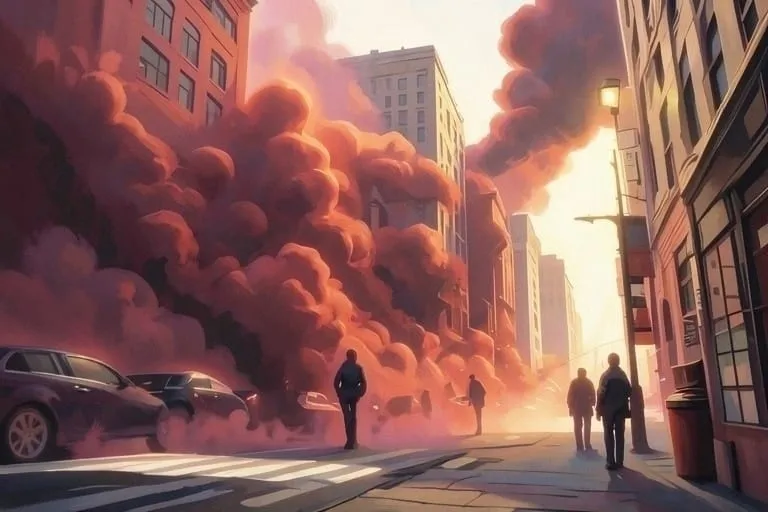
PART I
It is a curious thing, the way a human being will cling to a familiar pain rather than risk the terror of a new one.
Pain is the only thing we can truly guarantee another person will feel.
I see them every morning. The commuters. The clock-watchers. The ghosts in tailored suits. They move in synchronized rhythms, a sea of grey flesh and polished leather, each believing they are the protagonist of a very small, very important story.
I watch them trade it in small, shivering increments at the crosswalk, the way a shoulder jerks away from a touch or a jaw tightens in the silence between breaths.
They are changing.
I watched a man across the street try to eat a sandwich while his hands shook. Not a tremor of age, but the vibration of a tuning fork hitting a frequency of pure, distilled panic. He didn't notice me. No one ever does. I am the smudge on the peripheral, the static between channels, the man who blends into the grey concrete of a city that has forgotten how to breathe.
He had a quirk, a habit of tapping his collarbone three times whenever he lied. He did it while talking to his wife, and he did it while tipping his hat to the neighbor. I watched him for a week. The tapping stopped on Tuesday. By Wednesday, he stopped tipping his hat. By Friday, he had stopped blinking.
Take the man at the corner of 5th and Main. A bank teller. Six months ago, his greatest aggression was a sharp sigh when a customer fumbled for change. Yesterday, I watched him lean in and whisper something into a stranger's ear, something that made the stranger’s face go pale, and then he smiled. It was a tight, predatory expression. A rehearsal.
The contamination didn't start with a scream, but with a whisper in the potting soil of rural porches and the dim basements of forgotten counties. It was quiet, at first, fanned by men who knew exactly which nerves to pinch to make a population twitch. It has found the concrete veins of the city now, migrating from the cornfields to the skyscrapers, wearing a smile that doesn't reach the eyes.
Then there is the woman in the floral dress. She used to prune her hedges with delicate, almost surgical precision. Now, she shears them until the stems bleed sap, her eyes fixed on a horizon only she can see.
I saw a woman in the subway today. She was elegant, smelling of expensive lilies and old money. She was humming a tune, something melodic and ancient, while she watched a teenager across the aisle. The boy was staring at her, his eyes wide, his breath coming in ragged, wet gasps. He was afraid. I noticed the way she looked at him; it wasn't pity. It was the look of a butcher evaluating a slab of beef.
She reached out and touched the boy's wrist, her fingers lingering on the pulse. He didn't pull away. He couldn't. Wide eyes now full of rage. The sandwich-man’s rage. The boy clinched his fists and followed her as she stepped from the train.
I wonder which of them will be the first to break.